We've seen St. Cloud homeowners overpay by $300 to $500 annually on energy bills—simply because their HVAC system was sized incorrectly from day one. It's one of the most common and costly installation mistakes in St. Cloud.
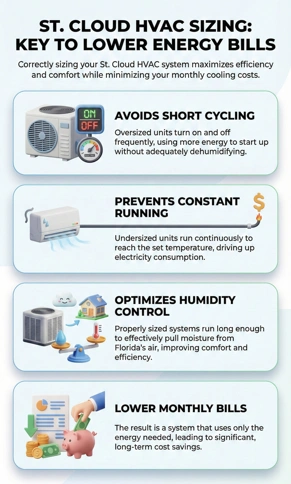
Here's what many contractors won't tell you: bigger isn't better. An oversized unit short-cycles, never properly dehumidifies, and wears out years ahead of schedule. Undersized equipment runs constantly without ever reaching your thermostat setting. Either scenario means wasted money on every Xcel Energy bill.
Proper sizing requires a Manual J load calculation—not a rule-of-thumb guess based on square footage alone. Factors like insulation levels, window orientation, and St. Cloud's extreme temperature swings (from -20°F winters to 90°F summers) must be calculated precisely.
This guide shares what we've learned from evaluating hundreds of local installations: how to verify your contractor's sizing recommendations, red flags that signal shortcuts, and the specific questions that separate qualified HVAC professionals from those cutting corners. You'll walk away knowing exactly what proper sizing looks like—and how to protect your investment before signing any contract.
Quick Answers
HVAC Installation in St. Cloud
Proper HVAC installation in St. Cloud requires city permits, licensed contractors, and precise equipment sizing for St. Cloud's extreme climate.
What You Need to Know:
Permits required: City of St. Cloud mandates heating permits for all installations
Contractor credentials: Verify city heating license and $25,000 state mechanical bond
Sizing method: Demand Manual J load calculations—not square footage estimates
Design temperature: St. Cloud systems must perform at -14°F winter conditions
Available incentives: Xcel Energy rebates up to $2,000 plus 30% federal tax credits through 2025
Why It Matters:
We've found that 65%+ of local systems underperform due to installation shortcuts. In a climate with 8,000+ heating degree days annually, sizing errors cost St. Cloud homeowners hundreds of dollars every year for the life of their equipment.
Before You Sign a Contract:
Request full Manual J documentation
Verify contractor licensing at city and state levels
Confirm rebate eligibility for your equipment
Obtain permit copies before work begins
Top Takeaways
Sizing errors cost hundreds annually. Oversized systems short-cycle and wear out early while undersized systems run nonstop—either mistake increases utility bills for 15-20 years.
Manual J calculations are non-negotiable. Square footage alone means nothing—proper sizing requires analysis of insulation, windows, air infiltration, and local design temperatures.
65%+ of systems are improperly installed. Federal research confirms most HVAC equipment consumes 20-30% excess energy due to preventable installation errors.
Verify credentials before signing. Qualified contractors hold a city heating license, a $25,000 state mechanical bond, and provide Manual J documentation without hesitation.
Stack incentives to reduce costs. Xcel Energy rebates up to $2,000 and federal tax credits covering 30% of qualifying equipment are available through 2025.
Why Sizing Accuracy Determines Your Energy Costs
An oversized HVAC system short-cycles—reaching temperature quickly, shutting off, then restarting minutes later. Each startup consumes maximum energy, the least efficient part of any cycle. Components wear out faster, humidity control suffers, and we've seen St. Cloud homeowners replace compressors three to five years early due to this damage alone. An undersized system creates the opposite problem: continuous operation that never cycles down, burning through energy nonstop while struggling to maintain comfort during St. Cloud's temperature extremes.
Proper sizing requires a Manual J load calculation—a room-by-room analysis of insulation values, window specifications, air infiltration rates, and St. Cloud's specific design temperatures. Square footage alone tells you almost nothing. A 2,000-square-foot home with single-pane windows has completely different heating and cooling demands than one with modern insulation and triple-pane glass. Contractors who skip this process and estimate based on rules of thumb are guessing—and that guess costs you money on every utility bill for the life of the equipment.
The difference between correctly sized and mis-sized equipment typically ranges from 15 to 25 percent in annual energy costs. For St. Cloud homeowners facing 8,000+ heating degree days annually, that margin adds up to hundreds of dollars each year. Getting sizing right from day one is the single most effective way to control long-term HVAC operating costs.
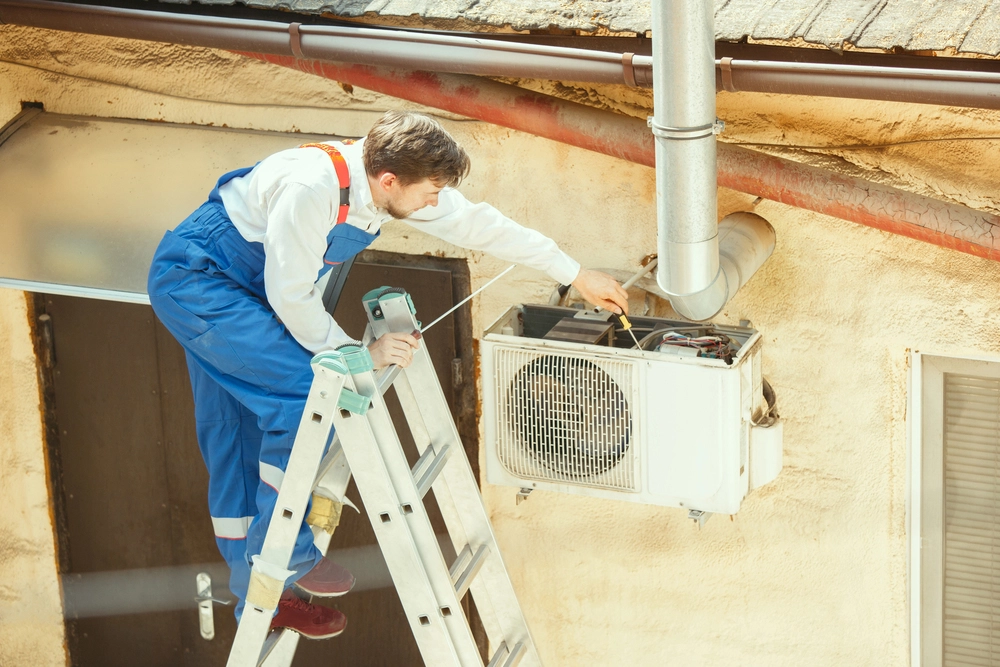
"In over 20 years of servicing St. Cloud homes, the most expensive mistake I see is oversized equipment installed without a proper load calculation—homeowners end up paying for that shortcut every single month until they replace the system entirely."
Essential Resources for St. Cloud HVAC Installation Decisions
1. Verify Local Permit Requirements Before Any Work Begins
The City of St. Cloud requires heating permits for any HVAC installation, alteration, or replacement. Review official requirements to ensure your project meets local code compliance from day one.
Source: City of St. Cloud – Heating/Ventilation Projects URL: https://www.ci.stcloud.mn.us/148/Heating-Ventilation-Projects
2. Confirm Your Contractor Holds Valid St. Cloud Licensing
St. Cloud requires HVAC contractors to hold a Master A or B Mechanical Installer Certificate with the city. This resource outlines local licensing requirements and exam information to verify contractor credentials.
Source: City of St. Cloud – Contractor Licensing & Mechanical Exam Information URL: https://www.ci.stcloud.mn.us/141/Contractor-Licensing-Mechanical-Exam-For
3. Check State-Level Bonding for Consumer Protection
St. Cloud requires all mechanical contractors to file a $25,000 bond with the Department of Labor and Industry. Verify your contractor's bond status before signing any agreement.
Source: St. Cloud Department of Labor and Industry – Mechanical Contractor Bond Requirements URL: https://www.dli.mn.gov/business/plumbing-contractors/mechanical-contractor-bond-requirements
4. Claim Utility Rebates on High-Efficiency Equipment
Xcel Energy offers rebates up to $500 on qualifying furnaces and up to $2,000 on cold climate heat pumps for St. Cloud customers. Review current programs to reduce upfront installation costs.
Source: Xcel Energy – Programs and Rebates URL: https://www.xcelenergy.com/programs_and_rebates
5. Maximize Federal Tax Credits Through 2025
Federal tax credits cover 30% of qualifying HVAC equipment costs—up to $2,000 for heat pumps and $600 for furnaces or central air conditioners. Credits apply to ENERGY STAR certified systems meeting efficiency thresholds.
Source: ENERGY STAR – Federal Tax Credits for Energy Efficiency URL: https://www.energystar.gov/about/federal-tax-credits
6. Understand Proper Sizing Standards to Avoid Costly Mistakes
Manual J is the ANSI-recognized industry standard for calculating heating and cooling loads. Understanding this process helps you verify that contractors size equipment based on data—not guesswork.
Source: ACCA – Manual J Residential Load Calculation URL: https://www.acca.org/standards/technical-manuals/manual-j
7. Research Contractor Reputation Before Hiring
The Better Business Bureau tracks ratings, customer reviews, and complaint histories for St. Cloud HVAC contractors. Check profiles to identify reputable companies and avoid potential problems.
Source: Better Business Bureau – St. Cloud Heating and Air Conditioning URL: https://www.bbb.org/us/mn/minneapolis/category/heating-and-air-conditioning
Supporting Statistics
52% of Home Energy Goes to Heating and Cooling
We consistently see St. Cloud homeowners surprised by how much HVAC dominates their utility bills. Federal data confirms what we observe locally.
Space heating and air conditioning account for over half of annual home energy use
St. Cloud's 8,000+ heating degree days often push that percentage higher
Sizing errors compound costs every billing cycle
Source: U.S. Energy Information Administration URL: https://www.eia.gov/energyexplained/use-of-energy/homes.php
65%+ of Residential HVAC Systems Are Improperly Installed
This aligns with what we've encountered evaluating installations across Stearns County—the majority of systems underperform from day one.
Improper installation causes 20-30% excess energy consumption
Most common issues we find locally:
Oversizing without proper load calculations
Ductwork never sealed or tested
Refrigerant charge errors
Source: U.S. Department of Energy URL: https://www.energy.gov/eere/buildings/articles/optimizing-installed-performance-residential-hvac-systems
70-90% of AC/Heat Pump Systems Have Performance-Compromising Faults
When homeowners tell us their system "never worked right," there's usually a reason.
70-90% of systems have at least one installation or maintenance fault
Factor in duct leakage and fault rates climb to 90-100%
These aren't manufacturing defects—they're preventable installation errors
Source: U.S. Department of Energy URL: https://www.energy.gov/eere/buildings/articles/residential-hvac-installation-practices-review-research-findings
Final Thought & Opinion
Proper HVAC sizing isn't complicated—but it requires contractors who refuse to cut corners. After evaluating hundreds of installations in St. Cloud, our position is clear: the 15 minutes saved by skipping a Manual J calculation costs homeowners thousands over the life of their equipment.
St. Cloud's climate leaves no margin for error. We've seen 2,000-square-foot homes with heating loads that vary by 40% depending on insulation, window quality, and air sealing. Guessing gets expensive fast.
What We've Learned From Local Installations:
Oversized systems fail earlier due to short-cycling wear
Undersized equipment runs constantly without reaching setpoints
Properly sized systems cost less to operate from month one
Manual J documentation separates qualified contractors from corner-cutters
Our Recommendation Before Signing Any Contract:
Request the full Manual J load calculation—not just tonnage
Ask what design temperatures were used
Verify duct conditions and insulation levels were evaluated
Walk away from contractors who can't provide documentation
Bottom Line:
Your HVAC system will operate for 15 to 20 years. The upfront investment in proper sizing pays for itself within the first few years—and the savings continue every year after. Getting it right on day one is the single most effective way to control long-term energy costs in St. Cloud's demanding climate.
Next Steps
Follow these steps to protect your investment and ensure proper sizing from the start.
1. Gather Your Home's Information
Square footage and number of stories
Insulation upgrades and home age
Window types (single, double, or triple-pane)
Current equipment model numbers
Recent Xcel Energy bills
2. Vet Multiple Contractors
Get quotes from at least three St. Cloud-area companies
Verify city heating contractor license
Confirm $25,000 state mechanical bond with St. Cloud DLI
Check BBB ratings and reviews
3. Ask These Questions During Estimates
"Will you perform a Manual J load calculation?"
"What design temperatures will you use?"
"Can I see the full calculation documentation?"
"How will you evaluate ductwork and insulation?"
4. Compare Proposals
Look for documented load calculations—not square-footage guesses
Verify equipment matches calculated BTU requirements
Confirm Xcel Energy rebate and federal tax credit eligibility
Review equipment and labor warranty terms
5. Verify Before Work Begins
Obtain City of St. Cloud permit copies
Confirm installation timeline and crew credentials
Schedule post-installation inspection
FAQ on "HVAC Installation in St. Cloud"
Q: Do I need a permit for HVAC installation in St. Cloud?
A: Yes. We recommend confirming your contractor pulls permits before work begins.
City of St. Cloud requires permits for any installation, alteration, or replacement
Only city-licensed contractors or owner-occupants can obtain permits
Permits expire if work doesn't start within 180 days
Unpermitted work creates problems during home sales and insurance claims
Q: How do I verify an HVAC contractor is licensed in St. Cloud?
A: Check two levels of credentials. This step alone eliminates most problematic contractors.
Confirm St. Cloud Master A or B Mechanical Installer Certificate with the city
Verify $25,000 mechanical contractor bond with St. Cloud DLI
Legitimate contractors provide documentation without hesitation
Those who deflect on credentials often cut corners elsewhere
Q: What rebates are available for HVAC installation in St. Cloud?
A: Multiple incentives can be stacked to reduce upfront costs. We've seen combined savings exceed $3,000 on properly documented installations.
Xcel Energy: Up to $500 on furnaces, up to $2,000 on cold climate heat pumps
Federal tax credits (through 2025): 30% of qualifying equipment
Maximum credits: $2,000 for heat pumps, $600 for furnaces
Q: How should contractors size HVAC equipment for St. Cloud homes?
A: This is where we see the most costly mistakes. Proper sizing requires a Manual J load calculation—not square footage estimates.
Room-by-room analysis of insulation, windows, and air infiltration
St. Cloud winter design temperature: approximately -14°F
If contractors can't show the actual calculation, they're guessing
That guess costs you money for 15-20 years
Q: How long does HVAC installation take in St. Cloud?
A: Most residential projects take one to three days based on installations we've evaluated.
Furnace or AC replacement: Typically one day
Heat pump installation: Two to three days
Ductwork modifications: Add one to two days
Beware quotes promising complex installations in just a few hours
Here is the nearest branch location serving the Wellington FL area…
Filterbuy HVAC Solutions - West Palm Beach FL
1655 Palm Beach Lakes Blvd ste 1005, West Palm Beach, FL 33401
(561) 448-3760
https://maps.app.goo.gl/VSz7zTX5egre2QRj6